-50x50w.jpg)


How to Choose Skis for Men/Adults
How to Choose Skis for Men/Adults: The Essential Guide for Maximum Power, Control, and Speed ⛷️
Choosing the right skis for a man (or, generally, for an adult skier) is a decision that directly influences performance, speed, and the level of effort exerted on the slope. Standard skis are designed to handle higher speeds and stronger torsional forces, requiring a specific construction.
This complete guide will walk you through all the crucial aspects – from understanding ski geometry and flex differences, to choosing the optimal length and width – so you can find the perfect tool tailored to your skiing style.
I. ? The Anatomy of Men's/Adult Skis: Key Features
Standard skis (often considered unisex or men's) are designed to handle greater forces and higher speeds, featuring the following main characteristics:
1. Stiffness (Flex) and Stability
Due to the higher body mass and higher centre of gravity of most men, the skis are built to be stiffer:
-
Increased Flexibility (Flex): Skis have a higher flex (they are stiffer) compared to women's skis. This ensures superior stability at high speeds and stronger energy return upon exiting a turn.
-
Dense Cores: Denser wood cores or layers of metal (Titanal) or carbon are often used. These add weight and rigidity, improving vibration dampening and edge grip on ice.
2. Binding Placement
Bindings are generally mounted in the "classic" position or slightly further back, allowing the skier to use body force and weight to drive the ski.
II. ? Ski Geometry: Camber, Rocker, and Sidecut Radius
Understanding the ski profile is essential for choosing the right tool for your favourite terrain:
1. Camber (Arch)
Ensures maximum edge contact with the snow throughout its length (under the bindings).
-
Benefits: Excellent grip on groomed slopes and ice, precise control, and energy on turn exit.
-
Ideal for: Speed, aggressive skiing on groomed terrain.
2. Rocker (Reverse Camber)
The raised curve of the ski tip and/or tail.
-
Benefits: Flotation in soft snow (powder) and easy turn initiation, preventing edge catching.
-
Ideal for: All-Mountain skiing, Freeride, variable conditions.
3. Sidecut Radius (RC)
Defines how tightly or broadly the ski's ideal turn radius is.
-
Small RC (under 15 m): Short, agile turns (Slalom).
-
Medium RC (15 m – 19 m): Versatility, medium turns, All-Mountain.
-
Large RC (over 19 m): High-speed stability, wide turns (Giant Slalom, Speed).
III. ? Types of Skis for Adults: Choose Your Domain
Your choice should reflect the predominant terrain you ski on:
| Ski Type | Waist (Width at Midpoint) | Stiffness (Flex) | Ideal Terrain |
| Piste Skis (Carving) | Under 85 mm | Medium-Stiff | Groomed slopes, hard snow, ice. |
| All-Mountain Skis | 85 mm – 100 mm | Medium-Soft | Versatility: 50% groomed / 50% variable snow. |
| Freeride/Big Mountain | 100 mm – 115 mm | Medium-Stiff | Deep snow (powder), ungroomed, woods. |
| Touring Skis | Varies | Soft (Ultra-light) | Uphill and downhill backcountry; low weight. |
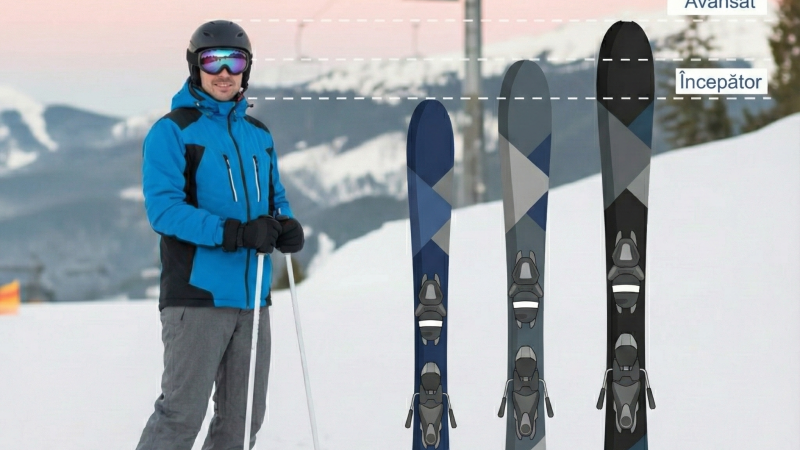
IV. ? Sizing Guide: The Perfect Length (Height, Level, and Type)
Ski length is vital and is determined by combining your height, weight, and, most importantly, your skiing level.
The Golden Rule of Length (Piste/All-Mountain):
The ideal skis should reach somewhere between your nose and your forehead level.
? Indicative Ski Sizes Chart for Men/Adults ?
| Skier Height (cm) | Beginner Level (Piste) | Intermediate Level (All-Mountain) | Advanced/Expert Level (All-Mountain/Freeride) |
| 160 | 145 – 150 | 150 – 155 | 155 – 160 |
| 165 | 150 – 155 | 155 – 160 | 160 – 165 |
| 170 | 155 – 160 | 160 – 165 | 165 – 170 |
| 175 | 160 – 165 | 165 – 170 | 170 – 175 |
| 180 | 165 – 170 | 170 – 175 | 175 – 180 |
| 185 | 170 – 175 | 175 – 180 | 180 – 185 |
| 190 | 175 – 180 | 180 – 185 | 185 – 190+ |
Essential Additional Adjustments:
-
Freeride/Powder Skis: Choose longer skis (up to your height or +5 cm) for maximum flotation.
-
Aggressive/Heavier Skier: Skiers who apply a lot of force and ski fast should choose the maximum recommended length or even slightly exceed it for stability.
-
Touring Skis: Shorter lengths are often chosen to reduce weight when climbing.
V. ? Tips for Beginner Adult Skiers
If you are an adult skier just starting out, focus on ease of control, not speed:
-
Choose Shorter Skis: A length that reaches your chin or chest is ideal. Shorter skis are easier to turn and more forgiving.
-
Focus on Narrow Waist: Choose Piste or All-Mountain skis with a waist under 85 mm. These are quick edge-to-edge, essential for initial turns.
-
Look for "Forgiving" Skis: Skis with a softer flex (for beginners) and rocker in the tip will help you avoid catching the edge and initiate turns effortlessly.
?️ Make a Smart Choice: Invest in Quality Without Exaggerated Prices!
Stiff, high-performance skis that include Titanal or carbon layers can be a significant investment. But you don't have to pay the full price to enjoy top-tier technology!
Our second hand ski and snowboard equipment store is the ideal solution. Find high-performance men's/adult skis from the biggest brands, all thoroughly checked and in excellent condition, at a fraction of the original price.
Start your next season with skis that perfectly match your power and style!
? Visit our collection of Second Hand Ski and Snowboard Equipment and find your perfect skis for maximum performance! ?️
 Custom image caption
Custom image caption
Video support
Banners with links
Custom image caption
Custom image caption
Custom image caption
Custom image caption
Custom image caption
Custom image caption
Custom image caption
Custom image caption
Custom image caption
Custom image caption
Image caption
Banner Link
Banner Link
Banner Link
Banner Link
Banner Link
Custom image caption
Custom image caption
Custom image caption
Video support
Banners with links
Custom image caption
Custom image caption
Custom image caption
Custom image caption
Custom image caption
Custom image caption
Custom image caption
Custom image caption
Custom image caption
Custom image caption
Image caption
Banner Link
Banner Link
Banner Link
Banner Link
Banner Link