-50x50w.jpg)


How to Choose Skis for Women – The Essential Guide
English Version: How to Choose Skis for Women – The Essential Guide
How to Choose Skis for Women: The Essential Guide for Maximum Comfort, Control, and Performance ⛷️
Choosing the perfect skis for women goes beyond simple colour or design. Modern women-specific skis are the result of detailed biomechanical studies, designed to maximize efficiency and minimize fatigue, taking into account the unique anatomy of female skiers.
This complete guide will take you through all the crucial aspects – from understanding ski geometry to choosing the optimal length and stiffness – so you can enjoy total control and superior performance on the slopes.
I. The Anatomy of Women's Skis: What Makes Them Special?
Skis labelled as Women's Specific Design (WSD) are not just scaled-down versions of men's skis. The differences are structural and essential:
1. Force Distribution and Binding Placement
Women generally have a lower centre of gravity and less upper body muscle mass.
-
Binding Placement: Bindings are often mounted a few millimetres further forward. This subtle shift helps the female skier maintain a more central stance and apply pressure more easily and efficiently to the tip of the ski, simplifying turn initiation.
-
Elevated Stance (Riser): Some models include plates under the bindings to slightly raise the heel, contributing to a natural stance and optimal weight distribution.
2. Flexibility (Flex) and Weight
WSD skis are built to be more accessible:
-
Optimal Flexibility (Flex): Skis are generally softer (more flexible) in the front and tail sections. This allows lighter skiers to effectively flex the ski into a turn (use the ski's energy), achieving better grip and control with less effort.
-
Lightweight Cores: Lighter materials (e.g., bamboo or advanced composite cores) are used to reduce the overall mass of the ski, reducing leg fatigue throughout the day.
II. ? Ski Geometry: Camber, Rocker, and Sidecut Shape
Understanding the ski profile is key to choosing the right tool for your favourite terrain.
1. Camber (Arch)
Camber is the slight upward arch in the centre of the ski when laid on a flat surface.
-
Benefits: Provides excellent grip on ice and hard snow and ensures powerful rebound (pop) upon exiting a turn.
-
Ideal for: Groomed slopes, speed, advanced skiers.
2. Rocker (Reverse Camber)
Rocker is the raised curve of the ski tip and/or tail.
-
Benefits: Helps the ski float on soft snow (powder) and facilitates entry and exit from turns (more forgiving).
-
Ideal for: Beginners (small rocker), All-Mountain, Freeride (large rocker).
3. Sidecut Radius (RC)
RC defines how sharply the ski turns. Measured in meters (m).
-
Small RC (under 14 m): Short, quick turns (ideal for slalom or narrow runs).
-
Large RC (over 17 m): Long turns, high speed, stability (ideal for giant slalom or fast descents).
III. Types of Women's Skis: Where Do You Want to Ski?
Your choice should directly reflect the percentage of time spent on different types of terrain:
| Ski Type | Waist (Width at Midpoint) | Ideal Terrain | Recommended Level |
| Piste/Carving | Under 80 mm | Groomed slopes, hard snow/ice. | Beginner – Advanced |
| All-Mountain | 80 mm – 95 mm | Versatility: 70% groomed / 30% soft snow. | All Levels |
| Big Mountain/Freeride | 95 mm – 110 mm | Soft, ungroomed snow, woods. | Intermediate – Expert |
| Powder | Over 110 mm | Deep snow only. | Advanced – Expert |
IV. ? Sizing Guide: The Perfect Length (Height, Level, and Type)
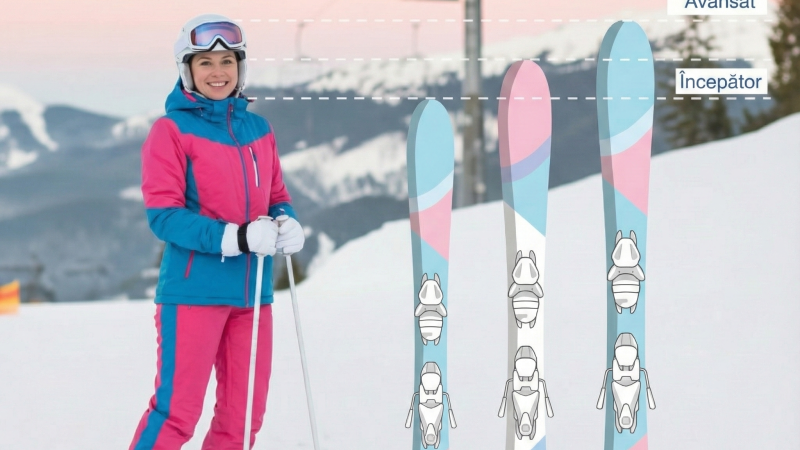
Ski length is determined by combining your height with your experience level and the chosen ski type.
The Golden Rule of Length (Piste/All-Mountain):
The ideal skis should reach somewhere between your chin and your nose level.
? Indicative Ski Sizes Chart for Women ?
| Skier Height (cm) | Beginner Level (Piste) | Intermediate Level (All-Mountain) | Advanced/Expert Level (All-Mountain/Freeride) |
| 150 | 135 – 140 | 140 – 145 | 145 – 150 |
| 155 | 140 – 145 | 145 – 150 | 150 – 155 |
| 160 | 145 – 150 | 150 – 155 | 155 – 160 |
| 165 | 150 – 155 | 155 – 160 | 160 – 165 |
| 170 | 155 – 160 | 160 – 165 | 165 – 170 |
| 175 | 160 – 165 | 165 – 170 | 170 – 175 |
| 180 | 165 – 170 | 170 – 175 | 175 – 180 |
Additional Adjustments:
-
All-Mountain/Freeride Skis: Add 5-10 cm to the recommended length for better floatation.
-
Beginners: Subtract 5-10 cm from the average length for increased manoeuvrability.
-
Weight/Speed: If you are heavier or ski at very high speeds, choose the maximum recommended length.
V. Tips for Beginner Female Skiers
If you are just starting your skiing adventure, simplicity is key to success and quick learning:
-
Choose Shorter, Softer Skis: A shorter length (reaching chest or chin) and a softer flex will allow you to execute turns with minimal effort.
-
Focus on All-Mountain (Narrow Waist): An All-Mountain ski with a waist between 70 mm and 80 mm will give you stability and control on groomed slopes.
-
Look for Rocker: A rockered tip facilitates turn initiation, making the experience more forgiving.
-
Don't Invest Heavily Initially: Your skis will change as you progress.
Equip Smartly: Discover Second Hand Equipment!
Women-specific ski equipment, with all its advanced technology, represents a major investment. However, you don't have to pay the full price for superior quality!
Our second hand ski and snowboard equipment store is the perfect destination. Here you will find late-model WSD skis from top brands, thoroughly checked and in excellent condition, at a fraction of the original price.
Take advantage of the opportunity to get the perfect skis for your anatomy and skiing style!
Visit our collection of Second Hand Ski and Snowboard Equipment and find your ideal skis for performance, without financial compromise! ?️
 Custom image caption
Custom image caption
Video support
Banners with links
Custom image caption
Custom image caption
Custom image caption
Custom image caption
Custom image caption
Custom image caption
Custom image caption
Custom image caption
Custom image caption
Custom image caption
Image caption
Banner Link
Banner Link
Banner Link
Banner Link
Banner Link
Custom image caption
Custom image caption
Custom image caption
Video support
Banners with links
Custom image caption
Custom image caption
Custom image caption
Custom image caption
Custom image caption
Custom image caption
Custom image caption
Custom image caption
Custom image caption
Custom image caption
Image caption
Banner Link
Banner Link
Banner Link
Banner Link
Banner Link